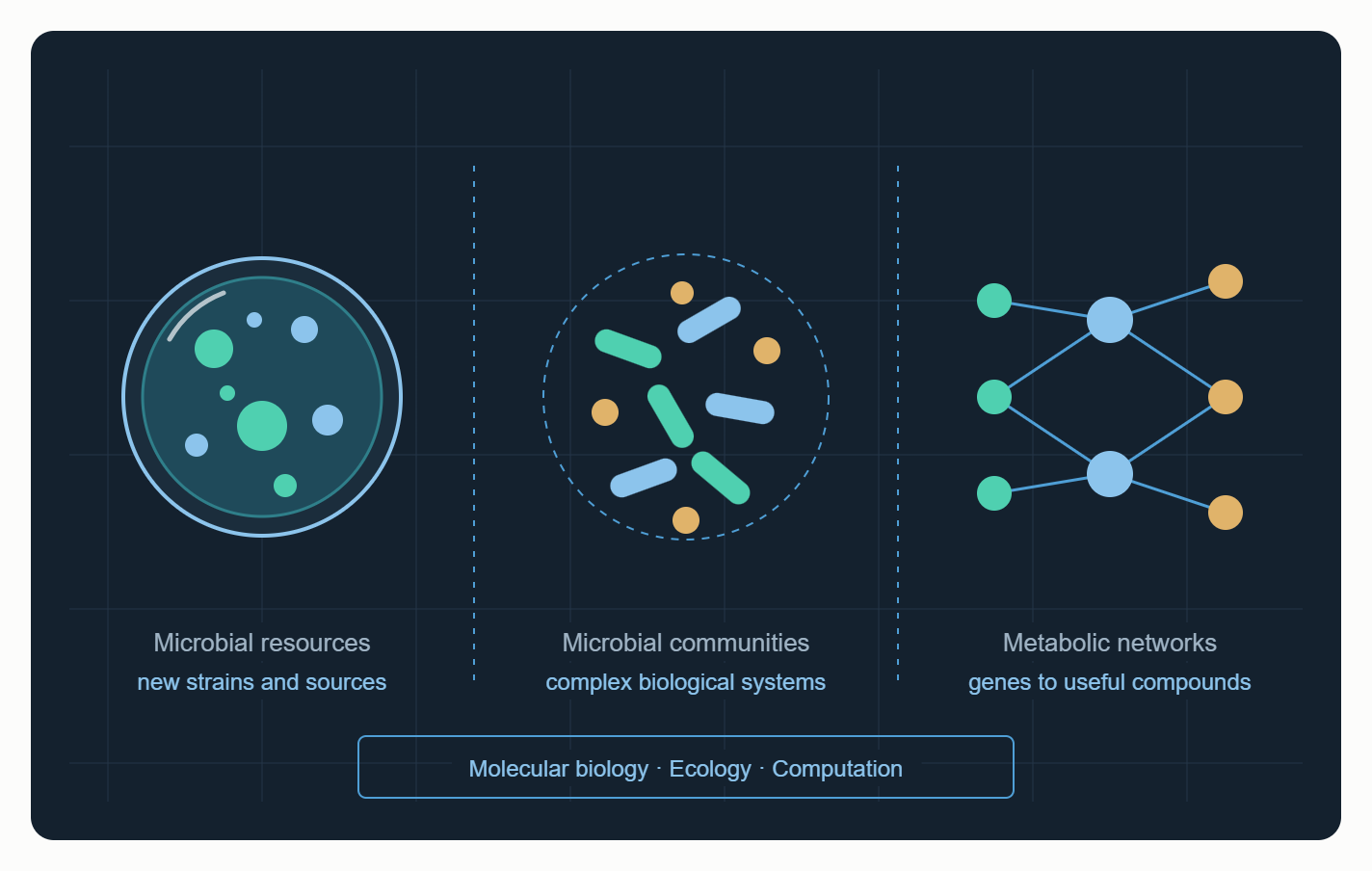
Microorganisms are essential components of the natural world. Although they are often invisible to the naked eye, bacteria, fungi, microscopic algae and other microbial organisms participate in biological processes that influence ecosystems, organic matter transformation and interactions between living organisms.
Microbial biotechnology explores these organisms and their biological activities to understand how microbial systems can be studied and used in scientific, environmental and industrial applications. By combining microbiology, molecular biology, genetics and biochemistry, this field reveals the remarkable diversity of microbial life and its potential for innovation.
What Is Microbial Biotechnology?
Microbial biotechnology is a branch of biotechnology that studies and uses microorganisms, their cellular components and their metabolic activities for specific purposes.
Microorganisms possess diverse biological characteristics that allow them to grow under different environmental conditions, transform organic compounds and produce a wide range of biological molecules. These properties make them important subjects in scientific research.
The field includes the study of microbial genetics, enzyme production, fermentation, environmental biotechnology and the development of biological production processes.
Rather than focusing exclusively on individual organisms, researchers also investigate microbial communities and the interactions that influence their behaviour.

The Diversity of Microorganisms
Microbial biotechnology begins with an understanding of microbial diversity. Different groups of microorganisms possess distinct structures, metabolic pathways and ecological roles.
Bacteria
Bacteria are single-celled organisms found in environments ranging from soil and freshwater to marine ecosystems and the surfaces of living organisms. Their metabolic diversity allows them to participate in nutrient cycling, organic matter decomposition and numerous chemical transformations.
Some bacterial species are studied for their ability to produce enzymes, synthesise useful compounds or transform substances within controlled biological processes.
Fungi and Yeasts
Fungi include diverse organisms that contribute to decomposition and the recycling of nutrients. Yeasts, a group of fungi, are particularly important in fermentation.
Certain yeast species transform sugars into other compounds through metabolic processes, making them valuable in food production, biotechnology and industrial research.
Filamentous fungi are also studied for their capacity to produce enzymes and other biologically active substances.
Microalgae
Microalgae are microscopic photosynthetic organisms that convert light energy into chemical energy. They contribute to aquatic ecosystems by participating in primary production and carbon cycling.
Researchers investigate microalgae for their potential in biomass production, environmental studies and the development of biological resources.

Archaea
Archaea are microorganisms that form a distinct group of life. Some are known for their ability to thrive in environments with extreme temperatures, salinity or acidity, while others inhabit more moderate conditions.
Their unique biological mechanisms provide opportunities to investigate cellular adaptation, microbial evolution and specialised metabolic processes.
Microbial Metabolism: The Chemistry of Living Cells
Microbial metabolism encompasses the chemical reactions that allow microorganisms to obtain energy, grow and maintain cellular functions.
These reactions can involve the breakdown of organic compounds, the synthesis of cellular components and the transformation of substances in the surrounding environment.
Microorganisms differ in how they obtain energy and carbon. Some use organic compounds, while others can use inorganic substances or carbon dioxide under suitable conditions.
Understanding microbial metabolism helps researchers explain why different microorganisms behave differently under particular environmental conditions. It also supports the investigation of biological processes used in fermentation, enzyme production and environmental biotechnology.
Fermentation and Biological Production
Fermentation is one of the most established applications of microbial biotechnology. It involves the use of microorganisms or their enzymes to transform substrates into products through biological reactions.
Depending on the organism and process, fermentation can produce organic acids, alcohols, enzymes and other useful compounds.
In food production, microbial fermentation contributes to the development of characteristic flavours, textures and preservation properties. In industrial biotechnology, microbial systems can be investigated for the production of selected molecules and biological ingredients.
The outcome of a fermentation process depends on factors such as the microorganism, available nutrients, temperature, acidity and oxygen availability. These variables influence microbial growth and metabolic activity.
Modern fermentation research therefore combines biological understanding with process monitoring and controlled production methods.

Microbial Enzymes and Biocatalysis
Enzymes are biological catalysts that accelerate chemical reactions. Microorganisms are important sources of enzymes because their diverse metabolic capabilities support the production of proteins with different functions.
Microbial enzymes are studied for applications in food processing, biotechnology, research and selected industrial processes.
Enzyme activity depends on molecular structure and environmental conditions, including temperature, pH and substrate availability. Researchers investigate these relationships to understand how enzymes function and how their activity can be maintained under particular process conditions.
Biocatalysis uses enzymes or biological systems to facilitate chemical transformations. Compared with some conventional chemical processes, selected biocatalytic methods can offer advantages in reaction selectivity and operating conditions, although their suitability depends on the specific application.
Microbial Genetics and Molecular Research
Microbial genetics examines how genetic information is organised, expressed and transmitted in microorganisms.
The study of microbial DNA and gene regulation helps researchers investigate characteristics such as metabolism, environmental adaptation and the production of particular biological molecules.
Molecular biology techniques can be used to identify microorganisms, compare genetic sequences and investigate relationships between genes and biological functions.
Genomic analysis has expanded the understanding of microbial diversity by allowing scientists to examine genetic information from cultured organisms and, through suitable methods, microbial communities.
These approaches contribute to research in microbial ecology, biotechnology and the study of biological evolution.

Microbial Communities and Environmental Interactions
Microorganisms rarely exist in complete isolation. In many environments, they form communities in which different species interact with each other and with their surroundings.
These interactions can involve competition for nutrients, the exchange of metabolic products and cooperative relationships that influence the functioning of the community.
In soil, microbial communities contribute to the decomposition of organic matter and the cycling of essential elements. In aquatic environments, microorganisms participate in carbon transformations and other ecological processes.
Researchers study these communities to understand how environmental conditions influence microbial composition and activity.
Microbial ecology also provides a scientific foundation for exploring applications such as biological waste treatment, nutrient recovery and the investigation of contaminated environments.
Microbial Biotechnology and Environmental Sustainability
Environmental biotechnology explores how biological systems can contribute to the management of environmental challenges.
Certain microorganisms can transform specific pollutants or participate in processes that reduce organic waste. These capabilities are investigated in areas such as wastewater treatment, bioremediation and the biological processing of organic materials.
The effectiveness of a microbial process depends on the characteristics of the microorganisms, the composition of the environment and the conditions under which the process operates.
For this reason, environmental applications require careful scientific assessment rather than assuming that a microorganism can remove every type of contaminant.
Research in this area helps improve understanding of biological treatment processes and the role of microorganisms in environmental management.
Emerging Technologies in Microbial Research
New analytical and computational approaches are expanding the possibilities of microbial biotechnology.
Genomic sequencing allows researchers to examine microbial genetic information, while proteomics investigates proteins produced by cells. Metabolomics focuses on small molecules involved in cellular metabolism.
When combined, these approaches can provide complementary information about microbial identity, biological activity and responses to environmental changes.
Bioinformatics supports the analysis of large biological datasets, helping researchers identify patterns and investigate relationships that may be difficult to recognise through individual measurements.
Another important development is the study of microbial communities through metagenomics, which examines genetic material recovered directly from environmental or biological samples. This approach can reveal information about microorganisms that are difficult to study using conventional cultivation methods.
Together, these technologies contribute to a more comprehensive understanding of microbial systems.
Challenges and Considerations in Microbial Biotechnology
Despite its potential, microbial biotechnology involves scientific and practical challenges.
Microorganisms can respond differently to changes in temperature, nutrient availability, acidity and other environmental conditions. Maintaining consistent biological activity may therefore require careful process development and monitoring.
Contamination, genetic variation and differences between laboratory experiments and larger production systems can also influence results.
In addition, the use of microorganisms must account for organism-specific characteristics, environmental considerations and appropriate biosafety requirements.
Reliable microbial research depends on suitable experimental design, validated analytical methods, accurate documentation and responsible handling of biological materials.
The Future of Microbial Biotechnology